Tanker Reserve Plan Shifts After Capture Failure
The sixth and final Tanker Class B vehicle, TSB-7, failed to achieve Mars orbital insertion after an aerocapture anomaly during approach. The vehicle had been intended to serve as an orbital reserve for Utopia in the event of surface-to-orbit refueling shortfalls.
During arrival, TSB-7 skipped the upper atmosphere and missed orbital insertion, ending its planned role in the Mars logistics chain. Although the loss of that reserve capacity is significant, mission planners state that Utopia’s departure timetable remains unchanged.
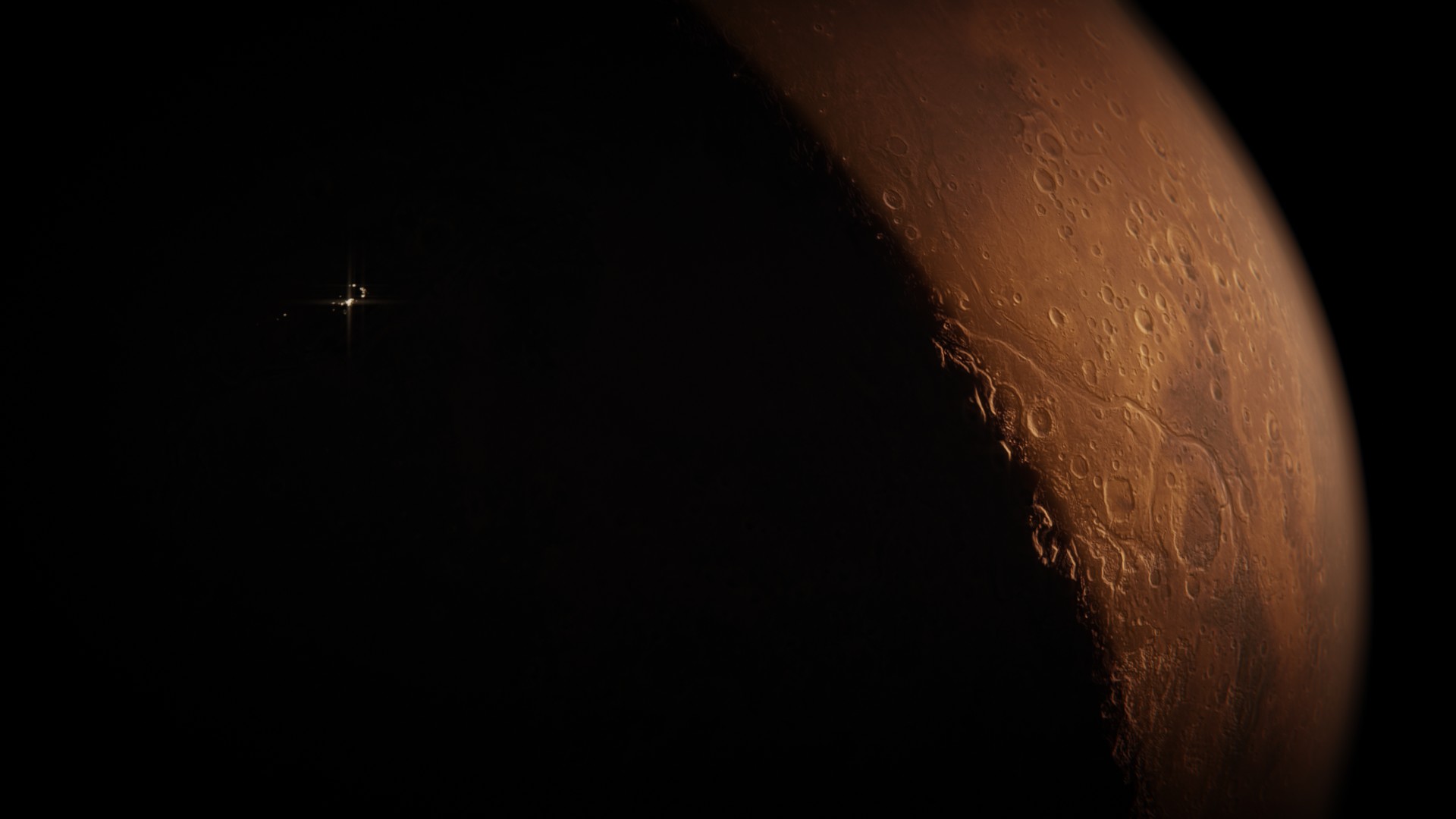
Placeholder image showing Terra Nordica from orbit. No imagery was captured of TSB-7 during the Mars flyby.
“The loss of Mars capture is a failure by any serious measure, and we should describe it that way. But a failed objective does not have to become a wasted asset, and TSB-7 will now be turned into something useful beyond its original mission.”
Contingency Maneuver Redirected the Vehicle
Following the anomaly, a pre-encounter correction maneuver adjusted the Mars flyby geometry and used a gravity assist to place TSB-7 on an outbound trajectory toward the asteroid belt.
Although the vehicle no longer supports the active Mars logistics chain, it remains in service in a different role. In practice, the reassignment may ease support requirements for the planned Amundsen-1 geological survey mission aboard True North, which will now no longer require separate tanker support for operations toward the asteroid belt.
New Role: Deep-Space Reserve and Survey Support
TSB-7 has now been repurposed as a deep-space propellant reserve and survey support asset. What began as a failed Mars reserve insertion may ultimately become a useful deep-space logistics position, giving the vehicle a new role beyond its original mission.
The reassignment also means the outcome is not without strategic value. By remaining available farther out-system, TSB-7 can support future survey activity and provide reserve propellant capacity in a region where infrastructure remains limited.
Operational Outlook
For Utopia, the immediate mission profile remains intact. TSB-7 had been planned as a reserve asset rather than a primary source of fuel, and NURO says the ship is still expected to depart on schedule.
Attention is now shifting to options for the reserve return-fuel situation that TSB-7 was meant to help cover. Those alternatives are still being evaluated, but the current assessment is that the failed capture does not require any change to Utopia’s departure plan.
After losses and retirements across the program, TSB-7 also marks the final Tanker Class B vehicle ever constructed. Its successor, TSC-1, is now nearing completion and is expected to begin orbital assembly in the later half of 2067. The new tanker class is designed around a higher propellant payload and will use the new L-Core engine, marking the next step in NURO’s deep-space logistics architecture.