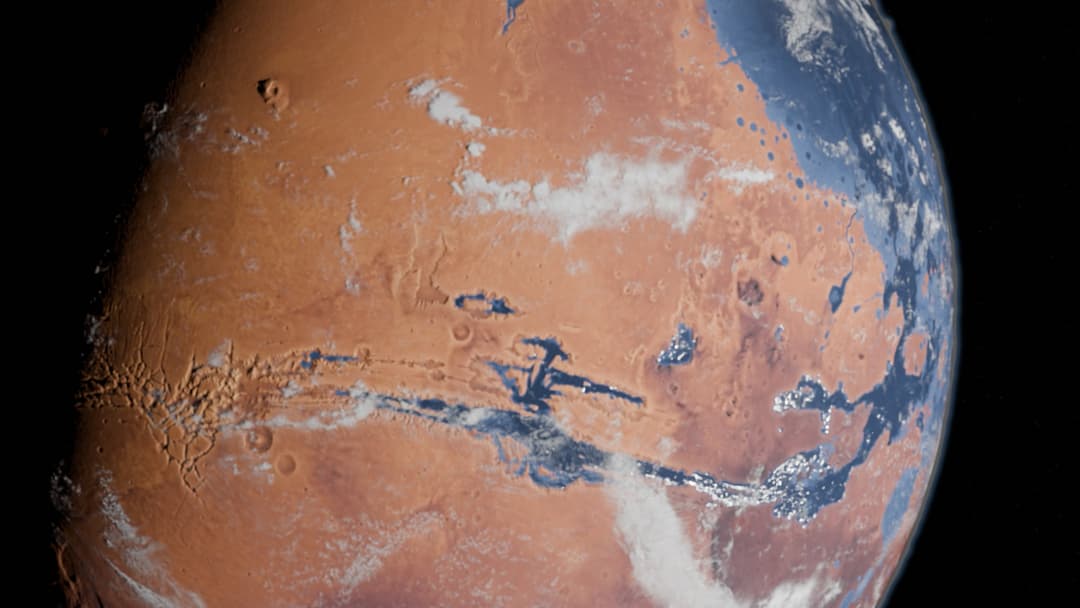
Kasei Valles
Terra Nordica is located in eastern Kasei Valles at 24.739°N, 296.844°E, where one of Mars’ largest ancient outflow channels meets the plains of Lunae Planum. Here we aim to explain why this exact spot was chosen. It walks through the ten key criteria that make the site strong enough to support long-term human activity on Mars.
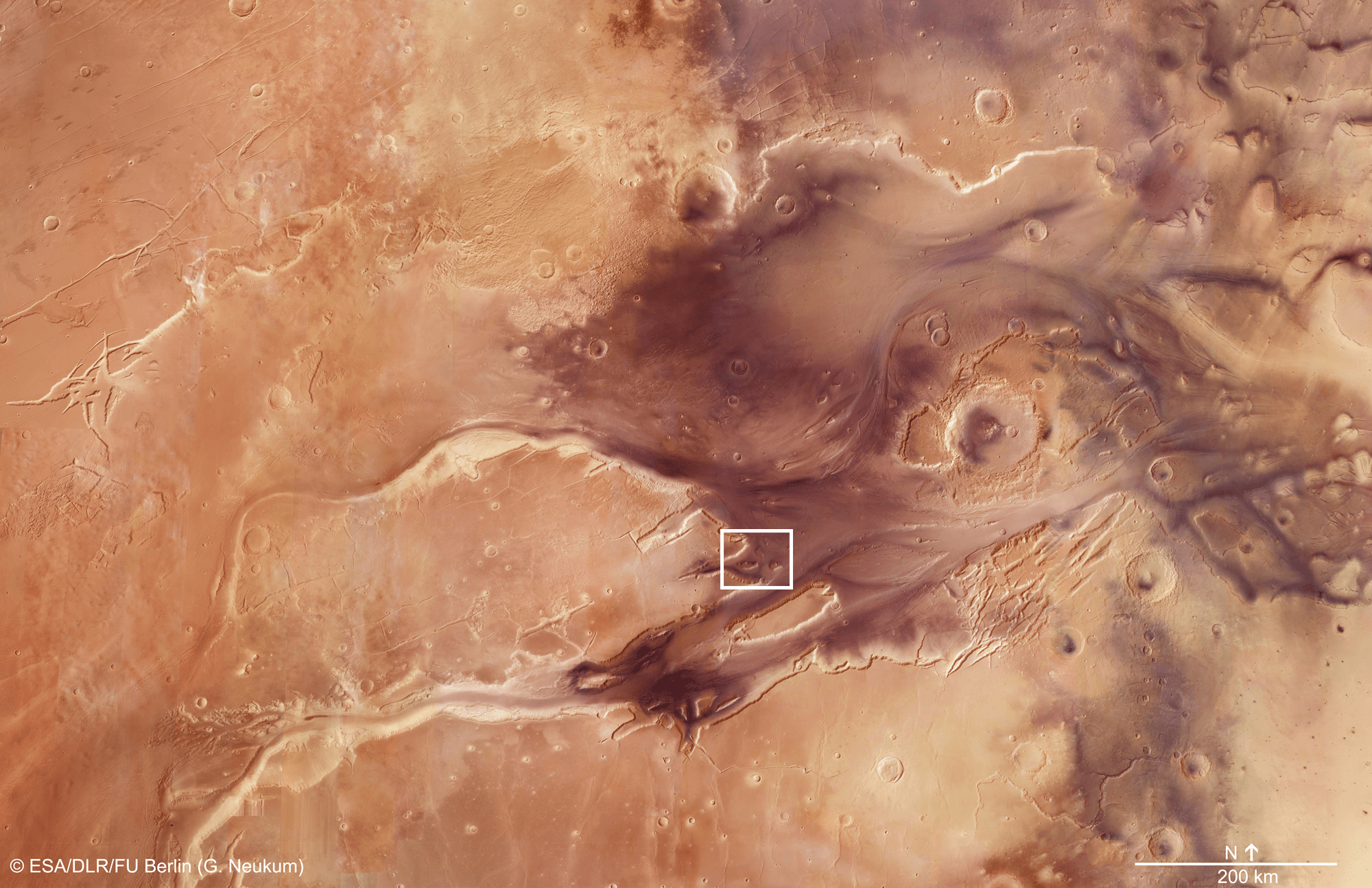
Eastern Kasei Valles
Lunae Planum margin · Terra Nordica marked by white square · East to West
1. Access to large and easily reachable ice resources
The most critical resource for any Mars colony is water. On Mars, water is primarily found in the form of ice, concentrated in large deposits around the polar regions. Satellite composites clearly show this global distribution. Over billions of years, climatic changes have caused much of this ice to gradually migrate toward the poles. As the axial tilt of Mars shifted over millions of years, temperature patterns changed, making the polar regions the most stable long-term cold traps for preserving surface and near-surface ice.
Source: NASA/JPL-Caltech (accessed 2026). Mars Water Maps.
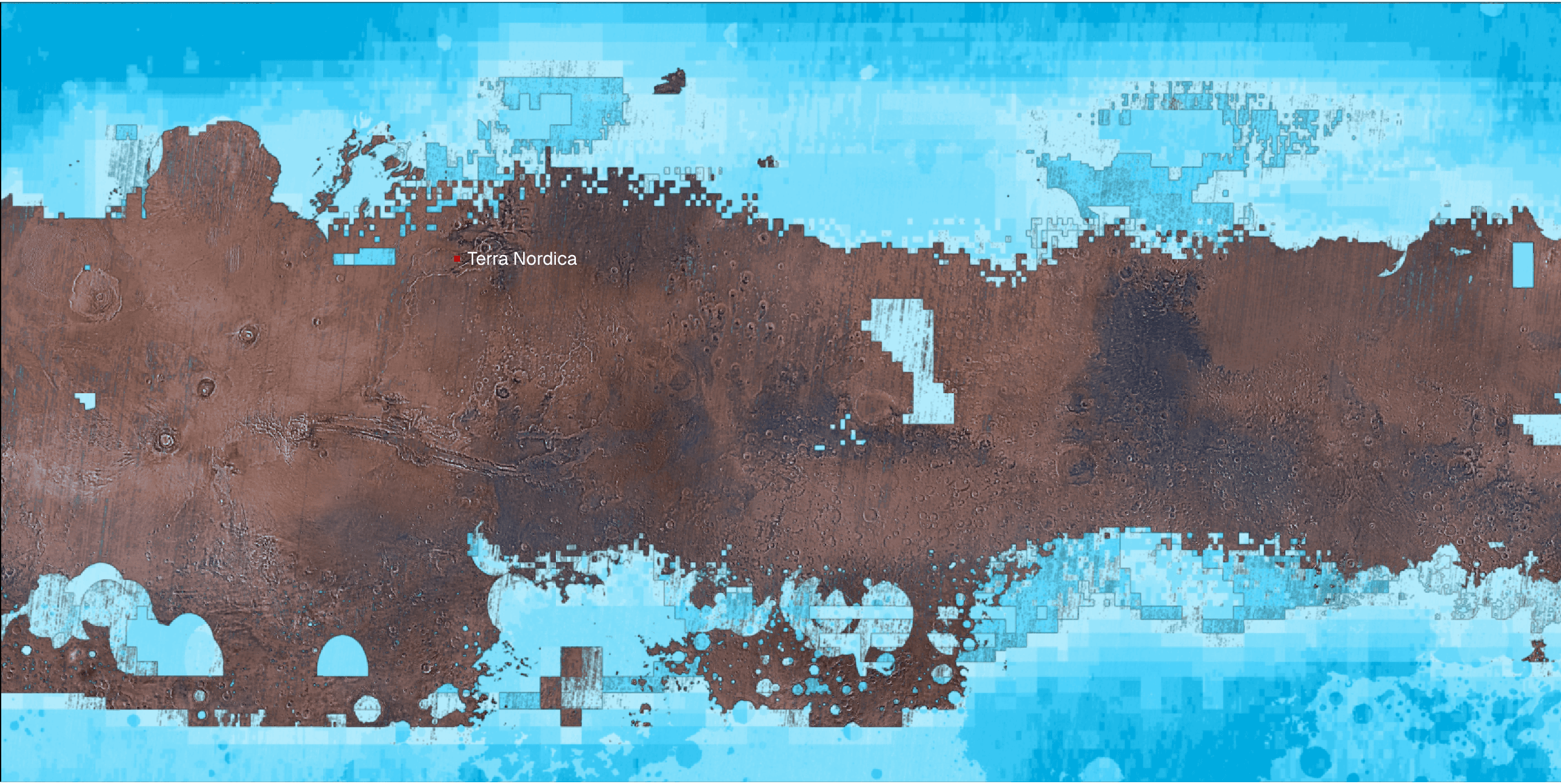
More recent data has significantly refined this picture. We now know that water ice also exists much further south than previously assumed, particularly at lower elevations and within ancient seabeds and outflow channels such as Kasei Valles.[info] In addition to subsurface ice, the region contains abundant water bound within hydrated minerals, further strengthening its suitability as a long-term settlement site.
Because water underpins life support, fuel production, and industrial processes, access to it is a non-negotiable requirement. Locations without reliable water resources are simply not viable for permanent settlement. For many years, Arcadia Planitia was considered the most attractive candidate due to its shallow ice deposits. However, with the wider Arcadia Planitia area claimed by China, NURO was required to evaluate alternative sites capable of supporting sustained habitation.
2. Hard-surface landing zone capable of supporting repeated heavy spacecraft landings and construction
The selected site lies along the boundary of older eHh (early Hesperian highland) terrain and Nhu (Noachian highland, undivided), as seen in the image to the right. These are geological map units: eHh indicates consolidated highland crust from the early Hesperian, while Nhu marks even older Noachian highland material mapped as one broad undivided unit. Both are ancient, mechanically strong crustal terrains, making the ground structurally stable. Although the colony is positioned close to the ancient riverbed of Kasei Valles, the settlement itself is located on this highland material rather than on loose channel sediments. This provides a hard, reliable surface well suited for repeated landings, takeoff operations, and long-term structural construction.
Building on this type of terrain significantly reduces the risk of subsidence, uneven settling, and dust-related erosion, while also simplifying the construction of heavy infrastructure such as landing pads, hangars, and pressurized surface modules.
A more detailed discussion of the local geological units is presented in the next section.
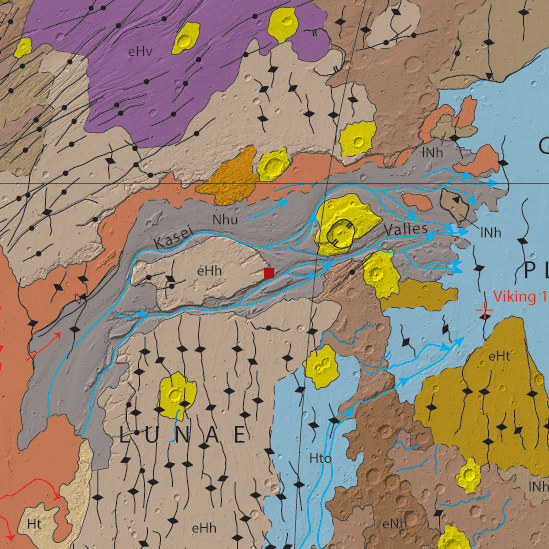
Geological Context
eHh and surrounding units
Source: Tanaka, K.L., Skinner, J.A., Dohm, J.M., et al. (2014). Geologic Map of Mars (USGS Scientific Investigations Map 3292).
3. High geological diversity supporting science and resource extraction
The Kasei Valles site was selected in part due to the close proximity of multiple distinct geological units, each offering unique scientific value and resource potential:
- eHh (Early Hesperian highland): Consolidated basaltic bedrock providing mechanically stable material for tunneling, heavy construction, and long-term habitat anchoring.
- Nhu (Noachian highland, undivided): Very ancient, water-altered crust rich in clays and hydrated minerals, offering high scientific value and potential water-bearing resources.
- ANa (Amazonian–Noachian apron materials): Reworked slope and margin deposits useful for studying erosion processes and mixed sedimentary resources.
- Kasei Valles channel deposits: Former outflow and riverbed materials, potentially containing ice-cemented ground and layered sediments related to past hydrological activity.
- AHi (Amazonian–Hesperian impact unit): Impact-related materials associated with regional impact structures such as Sharonov crater, exposing fractured and shocked crust that provides access to deeper subsurface materials.
- Hto (Hesperian transition outflow units): Outflow-related deposits extending into Chryse Planitia to the east, recording large-scale flood events and sediment transport.
- IHI (Impact-related Hesperian–Noachian lowland units): Older impact-modified plains further north in Acidalia Planitia, relevant for studying crustal evolution and basin-scale processes.
- AHv and HNt (Amazonian–Hesperian volcanic and Noachian transition units): Patchy volcanic and transitional terrains north of the site, indicating episodic volcanic resurfacing and thermal evolution.
- mNh (Middle Noachian highland): Ancient highland material east of the site, preserving some of the oldest exposed crust and early aqueous alteration signatures.
Source: Tanaka, K.L., Skinner, J.A., Dohm, J.M., et al. (2014). Geologic Map of Mars (USGS Scientific Investigations Map 3292).
4. Proximity to a mountain wall suitable for tunneled habitat construction
The primary reason for placing the settlement adjacent to a mountain wall is radiation protection. Mars lacks a strong magnetic field and thick atmosphere, exposing the surface to cosmic radiation and solar particle events. Tunneling habitats directly into rock provides passive shielding that is far more reliable and maintenance-free than surface-based solutions.
The preferred rock type for habitat excavation is competent, consolidated bedrock such as early Hesperian basaltic highland material. This type of rock offers predictable mechanical behavior, low fracture propagation, and long-term structural stability, making it well suited for large underground chambers and pressurized tunnels. As seen in the image below, the mountain just north of the Terra Nordica is the kind of mountain slope we are looking for, which is a big reason this site works for tunneled habitat development.
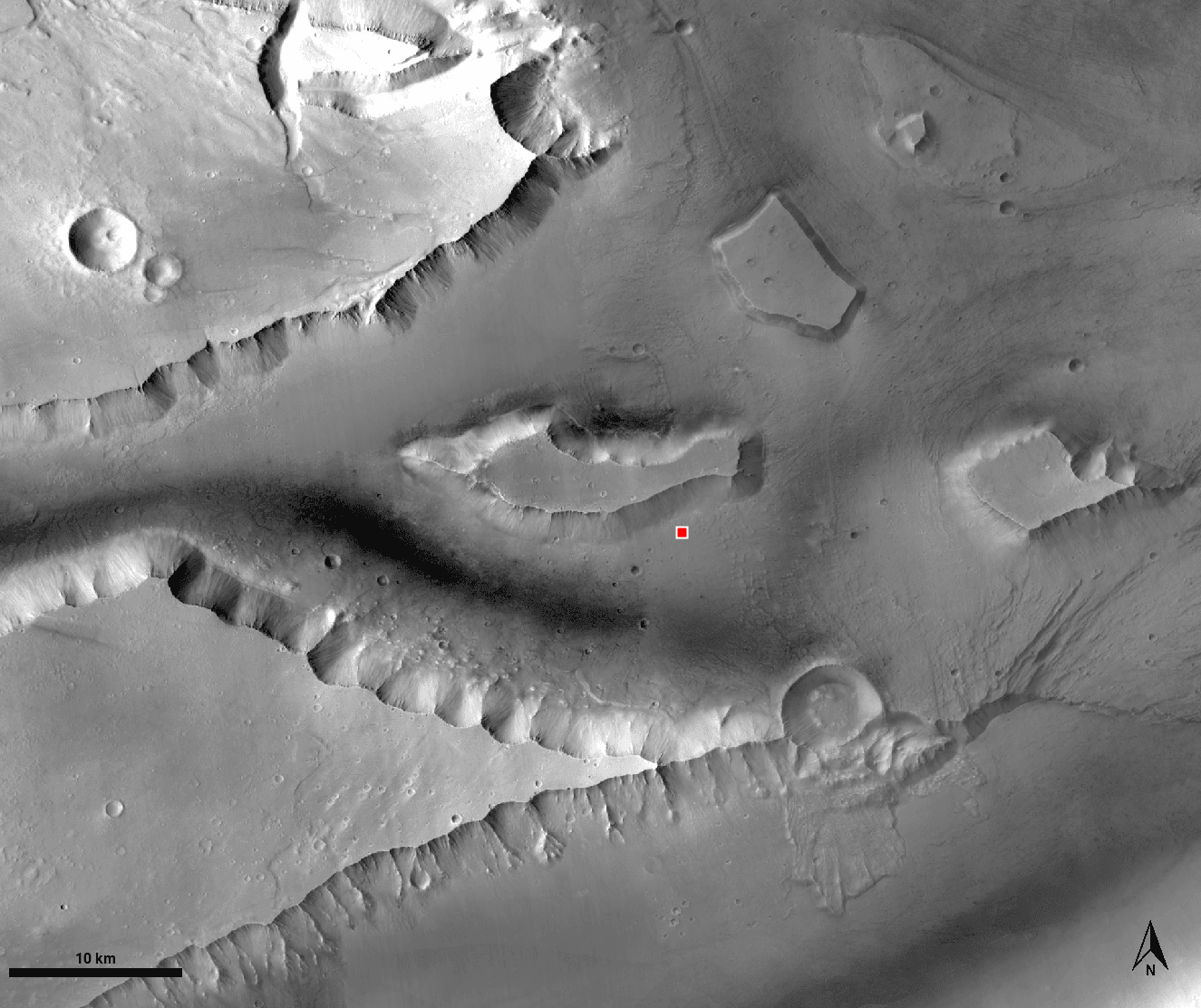
Terra Nordica Location
Eastern Kasei Valles · Colony marked by red dot
Source: Arizona State University Mars Space Flight Facility (accessed 2026). JMARS (Java Mission-planning and Analysis for Remote Sensing) application.
Source: Smith, D.E., et al. (2001). Mars Orbiter Laser Altimeter: Experiment summary after the first year of global mapping of Mars. Journal of Geophysical Research.
Slope geometry is equally important. A gently inclined or near-vertical mountain face allows horizontal or slightly downward excavation while minimizing the risk of mass-wasting events such as landslides, rockfalls, or slope creep. Avoiding heavily layered sediments and over-steepened scarps reduces the likelihood of slope instability over long timescales.
By selecting a stable, south-facing rock wall with limited evidence of recent erosion, the colony gains radiation protection, thermal stability, and structural safety without relying on complex surface shielding or deep vertical shafts.
5. South-facing slope optimized for solar power, communications, and thermal stability
This criterion directly complements the use of a mountain wall for tunneled habitats. A south-facing slope maximizes solar exposure in the northern hemisphere of Mars, improving the efficiency and reliability of surface-mounted solar arrays while also reducing seasonal shadowing effects.
In addition to power generation, elevated south-facing terrain provides improved line-of-sight for surface communications, relay antennas, and orbital links. Increased solar insolation also contributes to thermal stability, reducing heating demands and mitigating extreme temperature swings near habitat entrances and surface infrastructure.
6. Flat surrounding terrain for efficient traversal and construction
Flat terrain in the immediate vicinity of the settlement is essential for day-to-day operations. It simplifies surface traversal, vehicle movement, and the construction of infrastructure such as landing pads, pressurized modules, roads, and utility corridors. Level ground also reduces engineering complexity and long-term maintenance costs.
While closely related to the broader requirement for open terrain discussed in the next section, this criterion focuses specifically on the near-field environment directly surrounding the colony core, where operational efficiency and safety are critical.
7. Open terrain enabling unrestricted exploration and excavation
Beyond the immediate surroundings of the colony core, the wider region must remain open and accessible for large-scale surface operations. Open terrain enables long-range rover traversal, geological surveying, and the establishment of temporary field sites without the constraints imposed by steep slopes, enclosed basins, or heavily fractured terrain.
This requirement is mainly about finding useful resources in the ground, like ice, hydrated minerals, and construction material. It also means that once good target areas are mapped, teams can excavate safely and expand mining and processing operations step by step.
Unlike the flat near-field environment described in the previous section, this criterion applies at a regional scale. It ensures that the colony is not geographically constrained and can adapt its exploration and resource strategy as operational knowledge of the surrounding terrain improves over time.
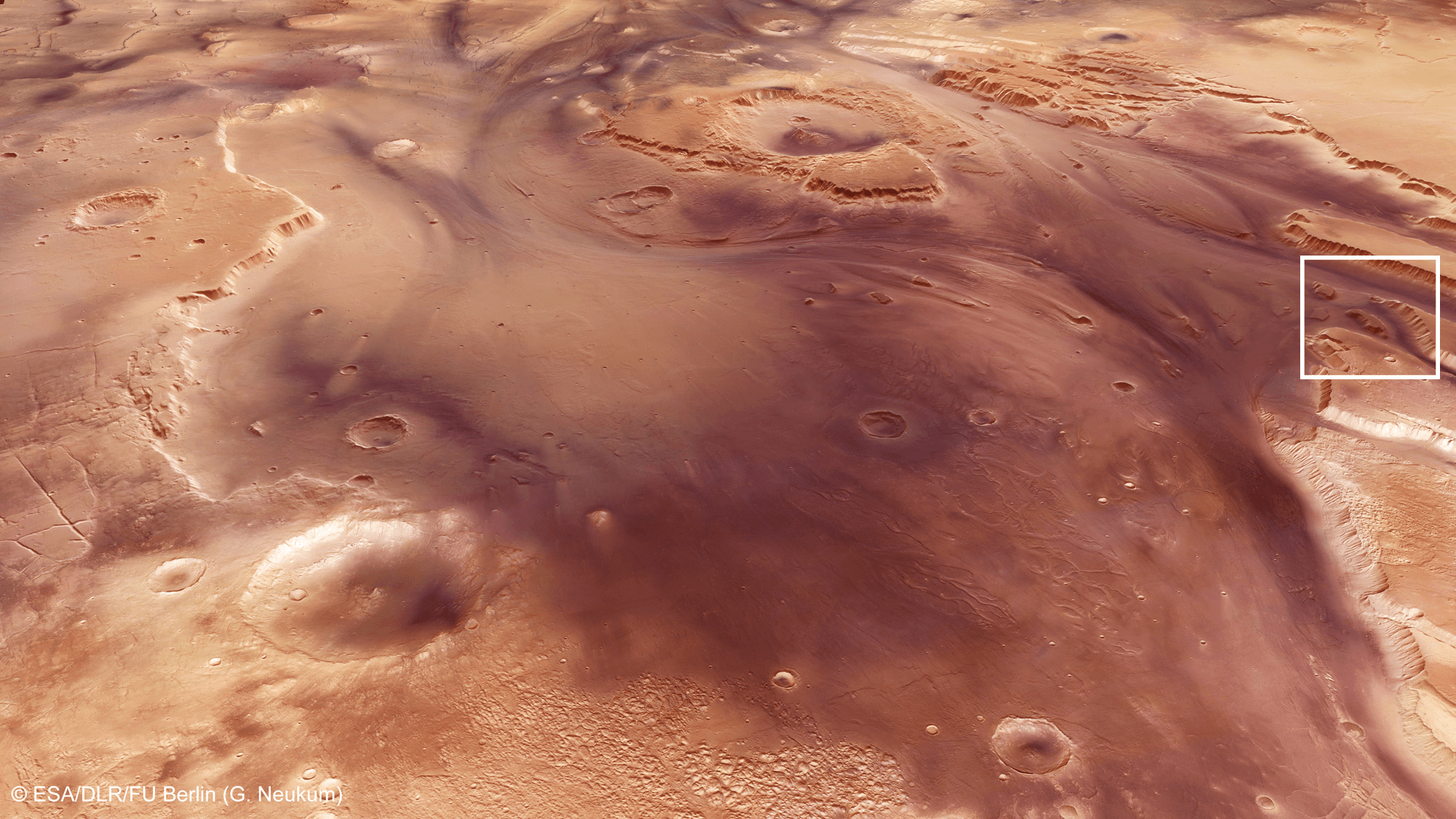
Eastern Kasei Valles
Lunae Planum margin · Terra Nordica marked by white square · East to West
8. Low elevation providing higher atmospheric pressure for landing and operations
The Terra Nordica colony site is located at an elevation of approximately −1,800 meters relative to the Martian datum, with surrounding terrain descending to around −3,000 meters based on MOLA 128 ppd elevation data. This places the settlement well within the northern lowlands, where atmospheric pressure is measurably higher than at average or highland elevations.
Higher atmospheric pressure directly improves Entry, Descent, and Landing (EDL) performance by increasing aerodynamic braking during atmospheric entry. This allows heavier spacecraft to land more safely and with greater margins, reduces fuel requirements during descent, and improves overall landing reliability.
Beyond landing considerations, increased ambient pressure also benefits surface operations by reducing dust suspension, improving thermal coupling with the atmosphere, and slightly lowering structural pressure differentials for pressurized habitats.
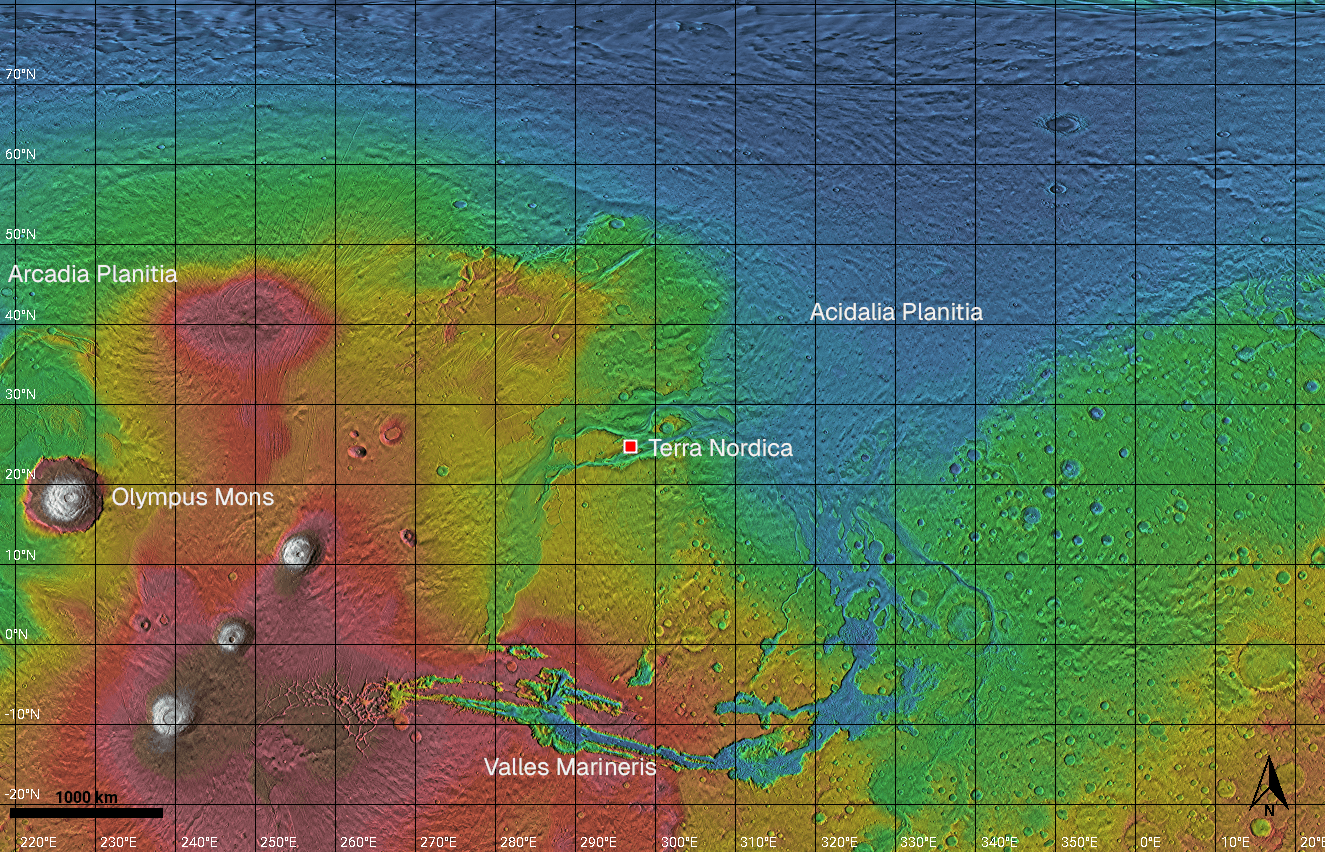
Height Map
North Western Quadrant of Mars
Source: Arizona State University Mars Space Flight Facility (accessed 2026). JMARS (Java Mission-planning and Analysis for Remote Sensing) application.
Source: Smith, D.E., et al. (2001). Mars Orbiter Laser Altimeter: Experiment summary after the first year of global mapping of Mars. Journal of Geophysical Research.
9. Near-equatorial location with a milder climate, reduced seasonal swings, and a takeoff boost
The Terra Nordica site lies at a relatively low northern latitude, close enough to the Martian equator to benefit from a more moderate climate compared to polar and high-latitude regions. Near-equatorial locations experience smaller seasonal variations in temperature and solar angle, resulting in more predictable environmental conditions throughout the Martian year.
Reduced seasonal extremes simplify thermal control for habitats, lower energy demands for heating, and improve operational reliability for surface systems and vehicles. A relatively low-latitude location also provides a modest rotational boost during takeoff, which is useful for ascent operations. This climatic stability is particularly important for long-duration missions and continuous habitation.
10. Scalable infrastructure supporting future population growth
The selected location provides sufficient flat terrain, structural bedrock, and open surrounding space to allow the colony to expand incrementally over time. Infrastructure can be added in modular phases without requiring relocation of core systems or disruption to existing operations.
Subsurface habitats can be extended laterally into the mountain wall, while surface facilities such as landing zones, power arrays, industrial areas, and research sites can be distributed across the surrounding plains. This flexible layout supports gradual population growth, increasing industrial capacity, and long-term self-sufficiency as the settlement evolves from an initial outpost into a permanent colony.
In the far-future Terra Nordica vision, this geography is also seen as a strong foundation for a large coastal city connected by river corridors and expanded transport networks.