Svalbard Training
The Svalbard Simulation Training Facility is Terra Nordica's primary pre-departure mission simulation site. It is used to test auronaut classes under prolonged isolation, operational routine, mission hierarchy, emergency response, and cold-environment surface conditions before departure for Mars.
Purpose
Svalbard is designed as a full-scale operational filter before launch. The objective is not simply to measure performance, but to expose weaknesses early, while failure is still instructive rather than catastrophic. During training, auronauts are placed under mission-like conditions and evaluated across medical, psychological, social, operational, and technical criteria.
The facility is used to stress-test crew and passenger routines, individual assignments, onboard responsibilities, emergency drills, system familiarity, isolation resilience, communication discipline, and the ability to function within a repetitive long-duration schedule.
Six-Month Simulation
The standard Svalbard program lasts six months and is divided into two main phases: three months inside the Utopia Center, followed by three months inside the Terra Nordica Mars Colony Center.
Utopia Transfer Simulation
First three months
The Utopia Center simulates the Earth-to-Mars transfer phase aboard a Utopia-class Mars liner. This phase represents approximately half of the real voyage duration and focuses on life inside the spacecraft: confinement, daily routines, operational tempo, role execution, onboard duties, system testing, emergency drills, and adaptation to long-duration mission life.
Terra Nordica Surface Simulation
Final three months
The second half of the program moves the class into the Terra Nordica Mars Colony Center, where the simulation continues in a cold, barren, Mars-analog environment. This phase tests surface operations, colony routines, environmental discipline, habitat procedures, and the transition from spacecraft life to settlement life.
Utopia Center
The Utopia Center is a ground-based mock-up of the Utopia vehicle, built to simulate the first half of the Mars journey: the transfer phase inside the spacecraft. It is not a perfect physical copy, because Earth gravity makes several parts of the real ship impossible to reproduce directly. Instead, the facility preserves the proportions, routes, systems, and operational logic of the spacecraft as closely as possible while adapting them to a fixed structure on the ground.
This phase represents approximately half of the real voyage duration and focuses on life inside the spacecraft: confinement, daily routines, operational tempo, role execution, onboard duties, system testing, emergency drills, and adaptation to long-duration mission life.
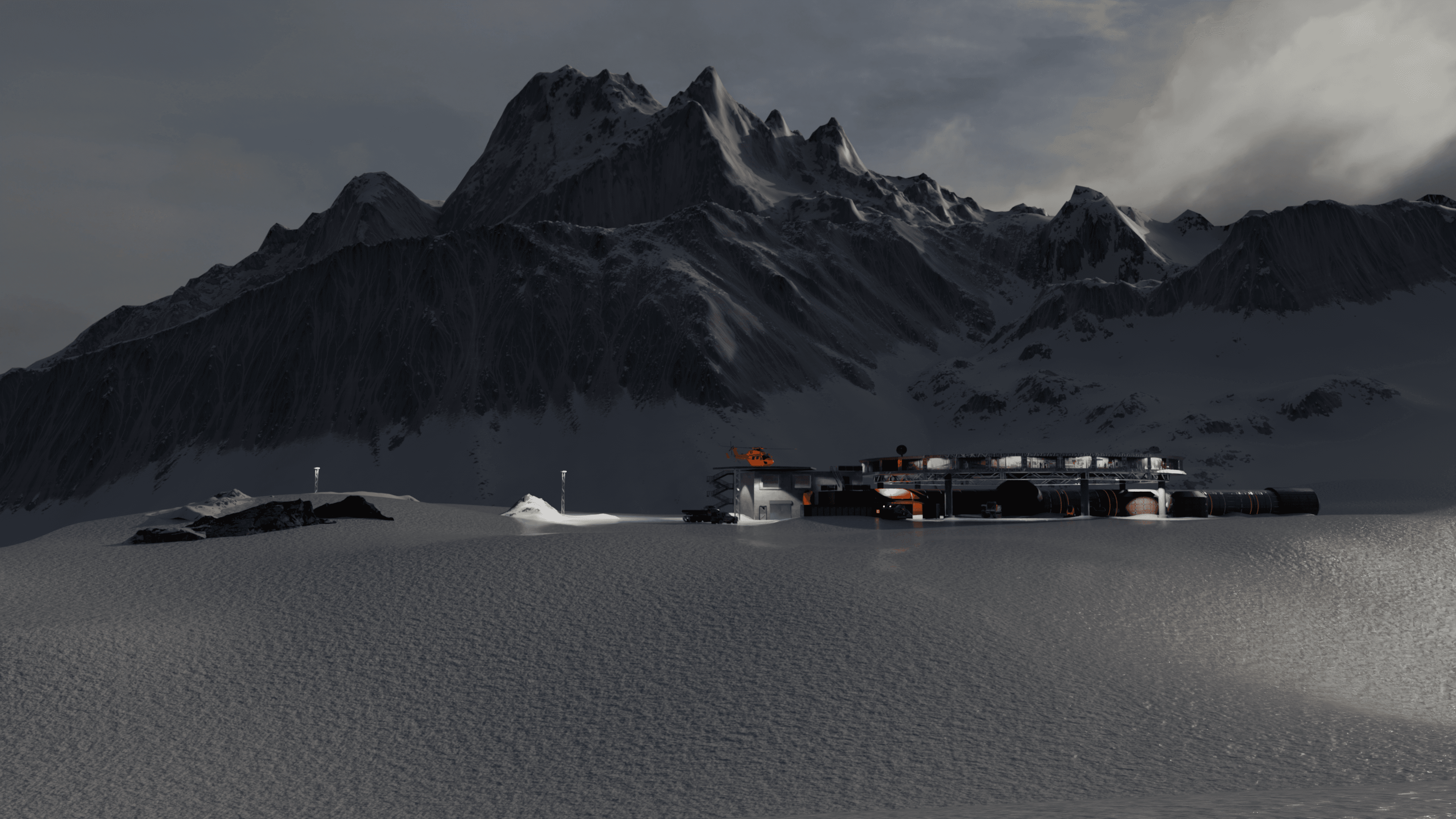
Svalbard Simulation Training Facility
Exterior · Shortly after completion · Arctic sunset
The exterior image shows the facility shortly after completion, during sunset in the Arctic environment. The Utopia Center is supported by a dedicated service facility that provides power, monitoring, storage, maintenance access, garage space, and operational support for the simulation staff. It also contains crew support areas such as sleeping quarters, kitchen facilities, control rooms, and logistics spaces needed to run a continuous three-month simulation.
The roof-mounted helipad provides emergency and logistics access in a location where weather, distance, and isolation can make normal transport unreliable. The surrounding support structures are part of the simulation environment as well: they allow the training facility to operate like a sealed mission site while still being monitored and maintained from the outside.
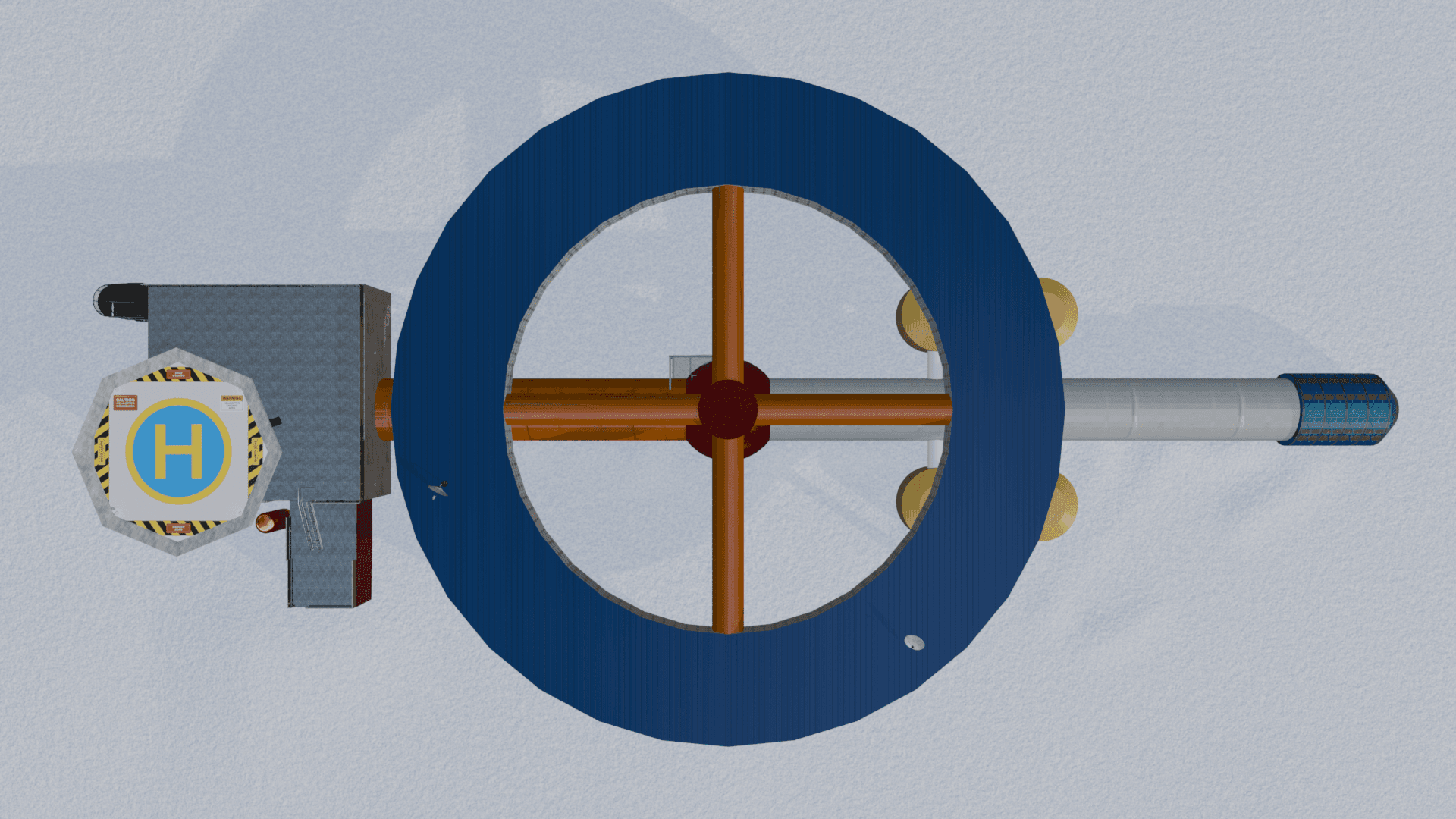
Utopia Center
Top-down view · Ring and spoke layout · Helipad, support buildings and service tunnels
Ring: In space, the rotating ring is used as a centrifuge, and people walk along what would visually appear to be the outer wall of the ring, on the windows. On Earth, gravity fixes the walking surface downward, so the ring has been widened while the ceiling height has been reduced. This keeps the usable width and height as close as possible to the real interior, but changes the coordinate orientation so it can function under normal gravity.
Elevators: On the real spacecraft, moving between the non-rotating central structure and the rotating ring involves a transition between zero gravity and centrifuge gravity. That cannot be reproduced on the ground. In the Utopia Center, these routes are more like simple tunnels leading between the modules. They preserve the travel paths, procedures, and separation between areas, even though they do not reproduce the real gravity transition.
Sphere: In the real spacecraft, the sphere is a zero-gravity volume used for movement, training, recreation, and other activities that depend on microgravity. In Svalbard, the sphere cannot function that way. It is instead used mainly as a connecting passage and orientation space, while still preserving the ship's overall layout and helping the simulation feel as close to the real vehicle as possible. An added segment above the sphere connects it cleanly into the rest of the ground-based structure.
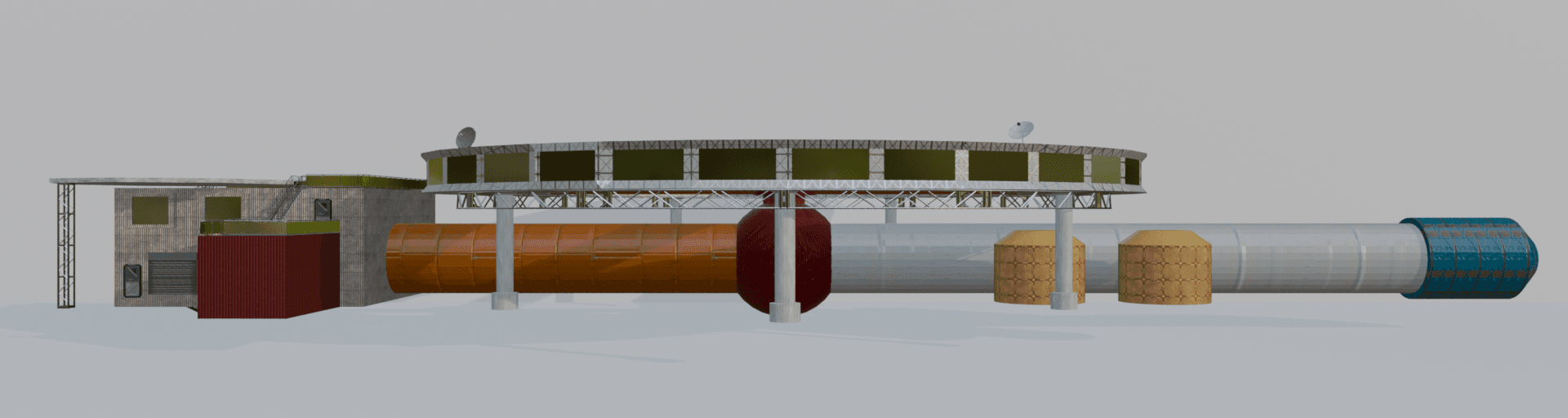
Utopia Center
Side elevation · Ring, central sphere, and service tunnels
Service tunnels: The maintenance and forward service tunnels are built as close to the real spacecraft design as possible, but with one major limitation: in space, the walls, ceiling, and floor can all be used as working surfaces. In Svalbard, only the walls function that way naturally. To compensate, the tunnels include an added footpath and can rotate to bring relevant machinery, panels, or training equipment into the correct working position for a specific exercise.
Sleeping modules: The pod dimensions are kept close to the real spacecraft design, but the sleeping pods are horizontal in Svalbard rather than vertical as they would be aboard the real ship. This preserves the confinement, privacy, and routine of the sleeping areas without forcing an impractical orientation under Earth gravity.
Other areas: require far less adaptation. The cockpit and airlocks are close to their intended spacecraft configuration, since their procedures, controls, and training value do not depend on microgravity in the same way. These areas are used for command training, emergency drills, ingress and egress procedures, and repeated practice of mission-critical routines.
Terra Nordica Mars Colony Center
The Terra Nordica Mars Colony Center represents the Mars surface phase. It is built to support colony procedures, outdoor environmental realism, and the operational expansion expected when large auronaut classes arrive on Mars.
This phase tests surface operations, colony routines, environmental discipline, habitat procedures, and the transition from spacecraft life to settlement life. The surrounding Arctic terrain serves as a stand-in for the barren Martian landscape.
The Cruiser Facility
The Svalbard site also hosts an older facility originally built for the Cruiser-class passenger ship, the predecessor to the Utopia-class liner. Unlike the Utopia Center, the Cruiser facility remains active and continues to be used for crew training, though for different missions than the original Earth-to-Mars passenger run.
Today the facility trains crews assigned to Skagerak, the space station in Mars orbit, as well as the crew of True North, the next crewed vessel departing for the asteroid belt. These missions share enough operational overlap with the original Cruiser profile — long-duration confinement, small crew dynamics, and remote operations far from resupply — that the existing facility remains fit for purpose without major modification.
Environment and Location
Svalbard was selected for its isolation, Arctic climate, and barren terrain. The surrounding polar landscape provides one of the closest Earth-based approximations of Martian surface conditions while still allowing access to permanent training infrastructure.
Training begins during polar night, when there is no sunlight. This is intentional: the lack of daylight increases the realism of long-duration spaceflight isolation and helps stress-test sleep discipline, mood regulation, and group stability. Later in the program, during the Mars-surface phase, continuous daylight returns. This is less ideal for Mars realism, but is an unavoidable consequence of operating above the polar circle.
Class Size
A full auronaut class may be larger than the final passenger group assigned to depart. For Voyage U-1M, the first Utopia journey to Mars, the Expedition 9 class entered Svalbard with 275 auronauts, while only 250 were expected to ultimately depart.
The surplus is deliberate. It accounts for expected drop-outs, including medical, psychological, operational, or behavioral disqualification during the six-month training program and afterwards.
Command Structure
The Svalbard simulation is run under a clear mission hierarchy. Auronaut classes train under crew command, but not necessarily under the crew that will accompany them on the real voyage.
Crews do not enter the simulation at the same time as the auronaut class. A crew completes its own Svalbard rotation an entire expedition cycle earlier — roughly two years before the class it will eventually command. By the time the auronaut class arrives, the crew has returned to active duty and is preparing for departure. They return to Svalbard solely in a command and oversight capacity.
This structure preserves realistic command conditions, avoids premature personal bonds between the class and their flight crew, and gives the commanding crew a full mission cycle of leadership experience before their own departure.
Training Focus
Svalbard combines technical, social, psychological, and operational evaluation. The program is designed to make the class live as if the mission has already begun.
- Adapting to repetitive mission schedules and routines
- Performing assigned onboard and colony responsibilities
- Maintaining physical training and sleep discipline
- Practicing emergency response and evacuation procedures
- Operating under confinement and limited privacy
- Managing interpersonal conflict and group stress
- Testing communication discipline and command hierarchy
- Identifying medical, psychological, or operational risks
- Validating habitat systems, modules, procedures, and routines
Role in the Mission Timeline
Svalbard training takes place late in the pre-departure sequence, after earlier Mars training, teamwork training, assignment training, emergency training, and space station exposure. By this stage, auronauts are expected to understand their roles and be ready for a continuous mission simulation.
After Svalbard, the class proceeds through debriefing, recovery, final psychological, medical, and physical testing, quarantine, transfer to the launch site, and the final departure sequence.