The Training is about to Peak
The arriving Expedition 9 Class marks the first full class of passenger auronauts to train inside the newly completed Svalbard Simulation Training Facility. Until now, the facility has only been used to train the far smaller Expedition 9 Crew, last year, making this the first large-scale operational test of the Utopia Center in its intended role.
The class consists of 275 aeronauts, 25 more than will ultimately depart aboard Voyage U-1M to Mars. The surplus is intentional though, accounting for expected drop-outs during the training program due to medical, psychological, or operational disqualification. It is also the first time many of the auronauts will formally interact with a Crew. The training is conducted under the command of the next expedition’s crew, a deliberate separation intended to keep clear command hierarchy and prevent personal bonds with the actual Expedition 9 crew, while simultaneously giving the following crew a full mission cycle of leadership experience ahead of their own departure.
Over the next six months, the class will undergo a continuous end-to-end mission simulation. The first three months will be spent inside the Utopia Center, simulating approximately half the real Earth-to-Mars voyage duration. The primary objective is to stress-test the class, requiring them to adapt to mission routines, individual roles, operational tempo, isolation, and a repetitive schedule, while taking on onboard responsibilities, system testing, and emergency drills.
Following this phase, the class will transition to the older Terra Nordica training facility, where the simulation continues in a simulated mars environment. The reason the training facility is on Svalbard in the first place.
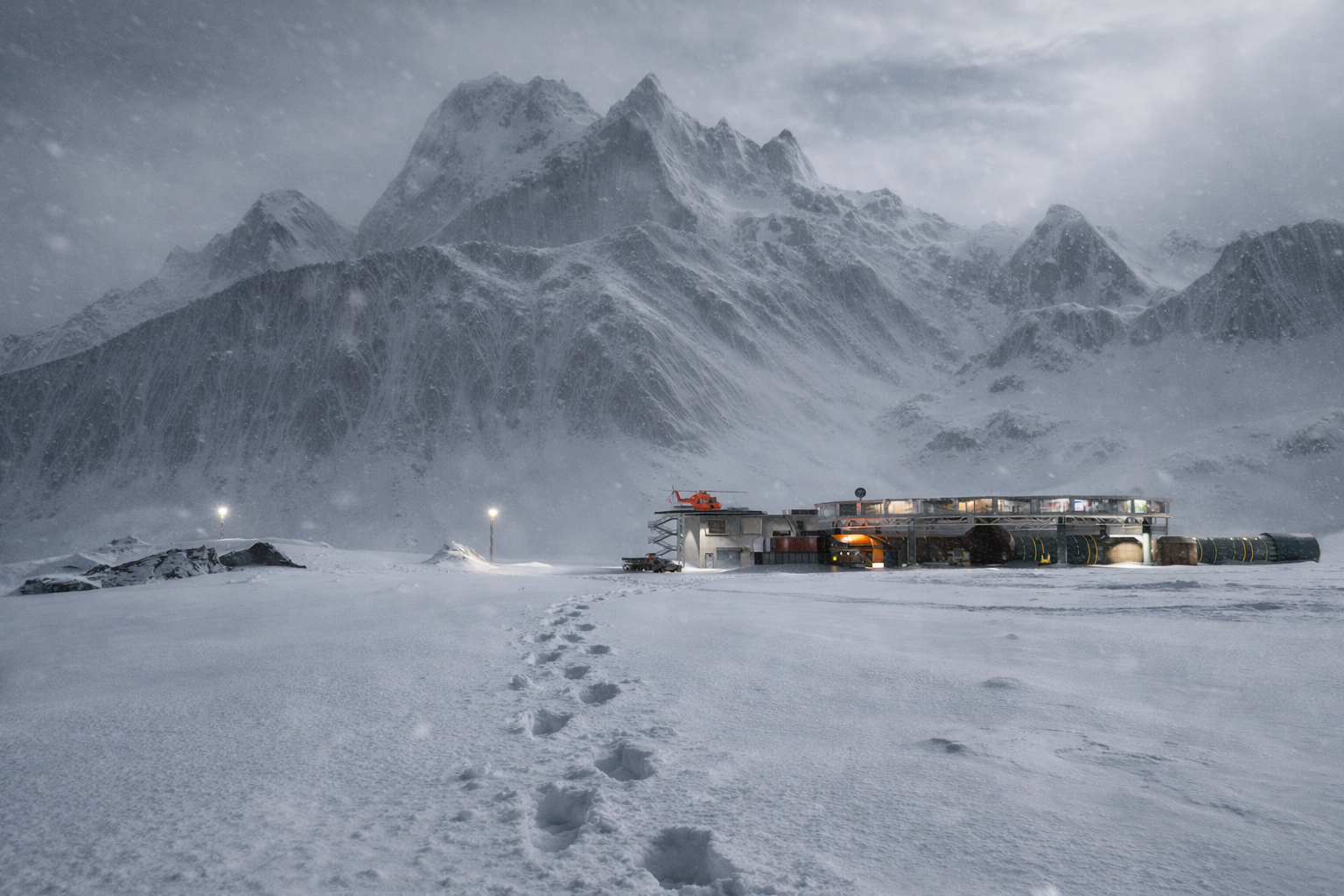
Picture of the Utopia Center facility, from last year, during Expedition 9 Crew Training when the sun was still above the horizon.
“This is the first time we are running the mission with a full class. It will be very interesting since this cohort of applicants have a broader qualification range, as planned. The objective here isn’t performance, it’s exposure. We want every weakness to surface now, in an environment where failure is instructive rather than catastrophic.”
— Director of Mission Simulation at Utopia Center, Noah Andersen
Svalbard was selected to maximize isolation and environmental realism. Its barren Arctic terrain provides the closest match to the Martian surface while allowing direct access to the Terra Nordica infrastructure already in place. The training period begins during polar night, with no sunlight, an intentional choice that mirrors long-duration spaceflight conditions. When the Mars-surface phase of the simulation begins later in the program, continuous daylight will return, a sub-optimal but unavoidable consequence of life here above the polar circle.
Notably, the Expedition 9 flight crew is not present at Svalbard during this phase. Instead, the training simulation is commanded by the crew from the subsequent Expedition 10, who will pilot the next Utopia-class Mars liner (not yet named). This structure allows Expedition 9 auronauts to train under realistic command conditions while providing Expedition 10 crew with early operational leadership experience.
Parallel to the training effort, the Mars Colony Center is undergoing rapid expansion. The upgrades are designed to mirror the growth of the Terra Nordica colony itself, preparing it to support the arrival of the 250 new auronauts aboard Utopia. At present, the colony population stands at 94, but the infrastructure development is rapidly speeding up to meet the demands of the upcoming missions.
Read more about the Svalbard Simulation Training Facility